
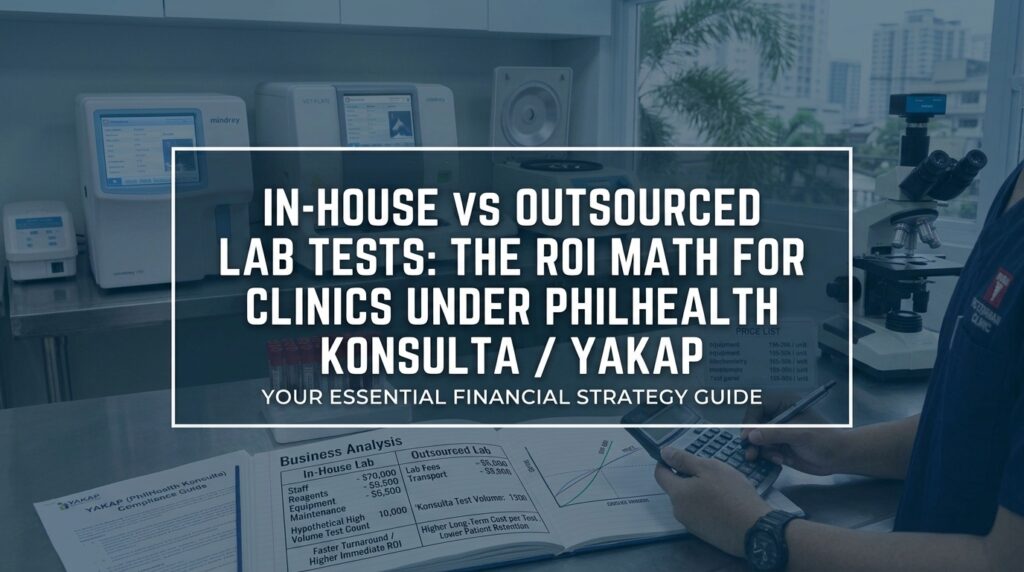
Choosing between in-house laboratory testing and outsourcing depends on how many tests your clinic performs and what each option costs. Bringing chemistry, hematology, electrolyte, and urine testing in-house may become financially worthwhile when savings on outsourced testing exceed the equipment and operating costs. PhilHealth YAKAP’s primary care services, including selected laboratory tests, make it worth reviewing these numbers.
For clinic owners, the goal isn’t simply to buy an analyzer. It’s to understand whether keeping certain tests onsite makes financial and operational sense.
What Is the Difference Between In-House Laboratory Testing and Outsourcing?
Many clinics will choose to send off samples to a partner laboratory. This can be a great choice if you aren’t doing too many tests. You won’t need to buy a laboratory analyzer, hire additional staff and you won’t have maintenance issues. However, you will have to rely on another establishment for processing and returning your results.
By doing in-house tests, you will have the samples processed in your licensed laboratory. This can help with convenience for regular testing. However, you will have to invest in equipment, reagents, quality assurance, trained staff and maintenance.
It really depends on how much you will be doing. If you don’t need to do many tests, then sending off to a partner laboratory may be the best option. However if you are consistently doing tests, then it may be worth seeing if you can save money by doing them in-house.
How Much Do Clinics Spend On Sending Testing Off?
Sending off samples to a laboratory may seem like an affordable option, however as your clinic grows more busy, the costs can add up. You may have to pay for shipping of samples, plus sample collection items. Plus you will pay for your staff to manage the results.
It may help to look back at any laboratory transactions you have had. How many samples have you sent off in the past three to six months and how much have you paid for each test?
Look for reference lab costs for the regular tests you send off. You may discover you’re spending a lot of money on a few regular tests. This will give you a good insight into which tests you may want to consider doing in-house.
What Tests Are Covered By PhilHealth Konsulta/YAKAP?
PhilHealth has developed the Yaman ng Kalusugan Program (YAKAP) to build on the original Konsulta package. Eligible members can access specific primary care services. This includes consultations, lab testing and diagnostic testing.
Tests available include:
- Complete Blood Count (CBC)
- Lipid Profile
- Fasting Blood Sugar (FBS)
- Creatinine
- HbA1c
- Urinalysis
- Fecalysis
- Faecal Occult Blood Testing
- Oral Glucose Tolerance Test
- Sputum Microscopy
- Pap Smear
- Chest X-Ray
- ECG
When looking at tests covered by PhilHealth Konsulta and PhilHealth YAKAP, this can help you see what lab tests may be relevant. However, this does not mean they will be automatically reimbursed. Clinics must ensure they are following current PhilHealth guidelines regarding indications, accreditation, provision of service and payment.
Why Should Clinics Consider Doing CBC, Lipid Profile, FBS, Creatinine & HbA1c Testing?
Certain tests will be requested more often. If you manage patients with Diabetes, Hypertension and other chronic diseases, you may request a Complete Blood Count, Lipid Profile, Fasting Blood Sugar, Creatinine and HbA1c regularly.
These tests can provide various information. The Complete Blood Count will show the components of your blood cells. Lipid testing can help show cholesterol levels. Fasting Blood Sugar and HbA1c can be used for blood sugar assessment. Creatinine will give information on kidney function.
If you are consistently doing these tests, it may be worth looking at whether you can save money by doing them in-house. However, you will need appropriate equipment, trained staff and a facility authorised to provide the service.
How To Work Out Break-Even Point For A Lab Analyzer
It can be helpful to ask yourself how many tests you would need to do each month to cover the costs of your equipment.
First ask yourself, how much are you currently paying to send off tests? How much would you expect to pay if you did them in-house? This will give you an idea of how much you can save per test. Once you know this, you can work out how many tests you would need to do to cover your fixed costs.
For example, if you are currently paying ₱250 per test to send off. If you did them in-house, you would spend ₱100 on reagents and other variable costs. This means you can save ₱150 per test. If your equipment costs and fixed costs totalled ₱30,000, you would need to do around 200 tests per month.
Sample Laboratory Break-Even Calculation
Cost Item | Illustrative Amount |
Outsourced testing cost | ₱250 per test |
In-house variable cost | ₱100 per test |
Potential savings | ₱150 per test |
Monthly fixed costs | ₱30,000 |
Break-even point | 200 tests per month |
Formula: Monthly fixed costs ÷ savings per test = break-even testing volume.
These figures are hypothetical and are not actual MEDTEK equipment prices or PhilHealth reimbursement rates. The calculation assumes the compared tests are equivalent and that all relevant operating costs are included.
What If You Do More Tests Per Month?
Once you reach your break-even point, doing more tests may actually be more cost effective. However this will depend on whether your costs are similar to the calculations you have done.
If you do 300 tests in a month. This would cost you ₱75,000 to send off. If you did them in-house, your variable costs would total ₱30,000. Plus your fixed costs of ₱30,000.
This means you could potentially save ₱15,000. This does not mean you will gain an extra ₱15,000 in revenue. It just means your estimated costs for tests per month would be less. However, you may not save the same as you may have reagent waste, repairs, staffing and fluctuating testing.
What Costs Should Clinics Consider For Lab ROI?
A common mistake clinic owners can make is not considering the full costs of running the equipment. Whilst you won’t have to pay for the equipment upfront, you will have regular costs.
These include reagents, consumables, quality controls, calibration, electricity, maintenance and staff. Some clinics may also need more lab space, renovation and software to manage results.
When calculating ROI on your automated chemistry analyser, try to use realistic calculations for your monthly running costs. Just because your machine can handle hundreds of samples per hour, it won’t be cost effective if you only use it a few times per day. The more realistic your calculations are, the easier it will be to compare different options and make a sensible decision.
Should I Buy An HbA1c Analyzer?
If you regularly see patients with Diabetes, then HbA1c testing may be part of your regular patient monitoring. This test can help determine average blood glucose levels over the past couple of months. This gives doctors useful information to help manage their diabetes.
If you are regularly sending off HbA1c samples, it may be worth looking at purchasing an analyzer. However, this will depend on how many tests you are doing per month.
Whilst looking at purchasing an HbA1c analyzer for use in Philippine Healthcare Facilities, look at the full costs. This includes reagent costs, maintenance, quality controls and overall cost per reportable result. Ensure the analyzer meets the requirements for the tests you want to carry out. If you don’t have many requests for HbA1c, it may be more cost effective to send them off.
What If My Equipment Needs Maintenance/Repair?
Having your own analyzer can make testing easier. However, like any medical equipment, you will need to regularly maintain, calibrate and occasionally repair your equipment.
If your analyzer breaks down, you may have to send your samples to a reference lab until the problem is resolved. This can cause additional costs. When purchasing your equipment, ask about maintenance.
Ask what is covered under warranty. How will you get your equipment serviced? Are spare parts easily available? Having an agreement with a qualified reference lab can also help. Adding this to your budget will give you a realistic idea of what owning lab equipment involves.
What Tests Should Clinics Do In-House?
If you are looking to do testing in-house, you don’t have to do all testing in-house. A more practical option would be to look at what tests your doctors are requesting the most.
Look through your lab records. What tests are you sending off the most? If you regularly do Complete Blood Count, selected blood chemistry tests and Urinalysis, it may be worth looking at these. Compare how much you are paying to send them off, with how much it would cost to do them in-house. Some specialist or infrequent tests may still be better to send off. Starting with a small menu of tests will make it easier to train your staff, track costs and quality control. Ensure any expansion you do fits within your DOH authorised lab capabilities.
How Can A Lab Starter Package Help With Costs?
Purchasing lab equipment can be tricky. You may be trying to budget for renovations, staff and other clinic costs. Each analyzer will require reagents, maintenance, installation and training.
A Lab Starter Package can help keep your equipment organised. Grouping your equipment together based on what tests you want to provide. This may include Chemistry, Hematology, Electrolyte and Urine Analyzers. Plus other lab equipment.
However, this isn’t necessarily the cheapest option. Look at what is included, reagent costs and what is included after installation. Ask for a detailed quote and compare the overall costs to what you are currently paying. Ensure the package fits your workload.
How Can MEDTEK Help With Lab ROI?
It can be overwhelming to decide if you should do lab testing in-house. We can help by having your lab testing records to hand.
We supply diagnostic equipment to healthcare facilities in the Philippines. This includes Chemistry, Hematology and Electrolyte Analyzers.
Before requesting a quote, write down what tests you are regularly requesting, how many tests you do per month and how much you are currently paying to send them off. This can help us talk through what equipment would be suitable for you and what costs could be. Once our guide is published, you can read our guide on setting up a Clinical Laboratory in the Philippines.
Frequently Asked Questions About In-House Laboratory Testing
Is In-House Lab Testing Cheaper?
Yes! If you are doing enough tests per month to cover your costs, in-house testing can be cheaper. However, if you aren’t doing many tests, you may find it is cheaper to send them off.
What Tests Are Covered By Philhealth YAKAP?
Philhealth YAKAP covers some tests including Complete Blood Count, Lipid Profile, Fasting Blood Sugar, Creatinine, HbA1c and Urinalysis. However, this will depend on indications, and programme requirements.
How Do I Work Out Break-Even Point?
Divide your fixed costs per month by your estimated saving per test. Ensure you include all relevant costs for your equipment, staff, maintenance and running.
Who Should Consider Doing Lab Testing In-House?
Clinics who have regular lab requests, appropriate facilities, qualified staff and enough resources may want to look at what the financial and operational requirements are for doing testing in-house.
Are All Lab Tests Automatically Reimbursed Under PhilHealth YAKAP?
No! Testing must comply with current PhilHealth benefits, clinical requirements, provider accreditation and payment.
Finding The Right Balance
Doing lab testing in-house can help with reducing costs if you are consistently doing tests. However, take your time to look at how much testing you are actually doing, how much you are paying to send them off and how much you expect to pay to run them.
If your clinic takes part in PhilHealth Konsulta or YAKAP, this can help you decide what lab services you may want to consider doing in-house.
Want to see if in-house testing would be a good financial decision for your clinic? Visit https://medtek.com.ph/ to enquire about an ROI Analysis and Equipment Demo. Subject to availability and confirmation.
For licensed and trained healthcare professionals. Financial examples are illustrative and do not represent guaranteed savings, PhilHealth reimbursement rates, or actual MEDTEK equipment prices. Laboratory operations must comply with applicable DOH licensing requirements and PhilHealth program rules.